Famous for a Tuesday: The Brutal, Hilarious, and Deeply Unfair Lottery of Going Viral on TikTok
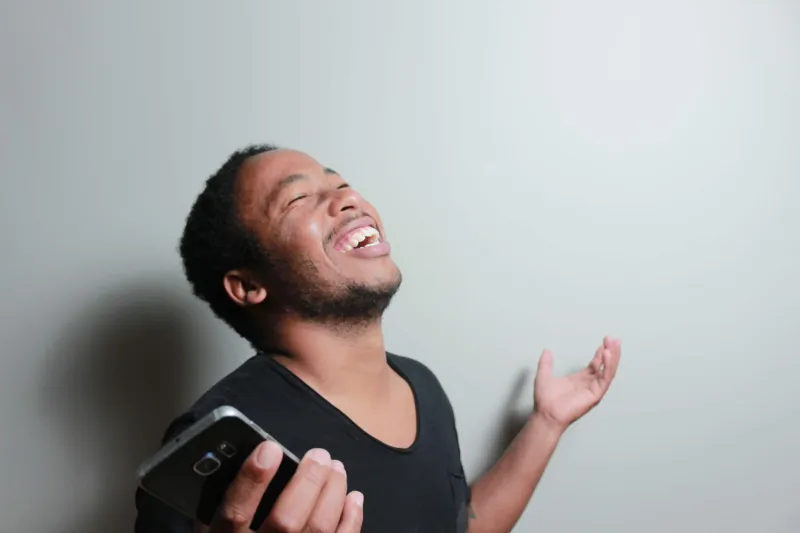
Photo: person excited looking at phone with viral notifications confetti, via www.goodfreephotos.com
Somewhere right now, a 24-year-old in Akron, Ohio is refreshing their TikTok notifications with the frantic energy of a man who just found a scratch ticket in an old coat pocket. The numbers are going up. Way up. Twelve million views on a video they made in eleven minutes while waiting for their Doordash to arrive. Their phone is physically vibrating off the nightstand. A brand DM lands. Then another. Someone on Twitter is quote-tweeting them. They are, for one shining, glorious, completely unearned Tuesday, famous.
By Thursday, it's over.
Welcome to the weird economy of TikTok virality in 2025 — a place where the algorithm is basically a chaos goblin with a slot machine, and the jackpot pays out in attention that evaporates faster than a Snapchat streak you forgot to keep.
The Twelve-Minute Fame Cycle (Yes, We're Updating Warhol)
Andy Warhol said everyone gets fifteen minutes of fame. Bless his heart. He had no idea the internet would eventually compress that down to roughly the runtime of a mid-length YouTube ad. According to data from multiple social analytics platforms, the average viral TikTok video reaches peak engagement within 48 hours and drops to baseline performance within five to seven days. That's not a career. That's a head cold.
What's genuinely wild is how complete that spike looks while it's happening. We're talking comments flooding in from people in countries the creator has never heard of. Duets from accounts with millions of followers. The intoxicating feeling that maybe, maybe, this is the beginning of something real.
Spoiler: for most people, it is not the beginning of something real.
It is, in fact, the entire something.
Meet the One-Hit Wonders Nobody Remembers
There's a whole shadow population of people who went massively viral once and then quietly returned to their regular lives, haunted by the ghost of their own metrics. You probably don't remember their names — which is, honestly, the whole point.
There was the woman whose video of her dog reacting to a specific chord on a ukulele got 18 million views in 2023. She posted 47 follow-up videos. The highest-performing one got 4,000 views. There's the guy who accidentally invented a dance move while tripping over his own cat and spent the next eight months watching other people get famous doing his move while his account flatlined. There's the teenager whose deadpan grocery store commentary blew up so spectacularly that a morning talk show flew her out — and then the algorithm decided it was done with her approximately two weeks before the segment aired.
These people are not failures. They are casualties of a system that was never designed to be fair.
The Algorithm Is Not Your Friend, Your Mentor, or Your Hype Man
Here's the uncomfortable truth that TikTok's very aesthetic of authenticity obscures: the For You Page is not a meritocracy. It is a prediction engine optimized for engagement, which is a polite word for the thing that keeps you doom-scrolling at 1 a.m. instead of going to sleep like an adult.
When a video goes viral, it's not because the algorithm decided you deserved it. It's because some combination of timing, trend adjacency, thumbnail luck, and pure statistical chaos aligned in your favor for approximately one news cycle. The algorithm gave you the ball. It did not promise to keep passing it to you.
Creators who've studied this phenomenon — and there is, delightfully, an entire cottage industry of TikTok strategists who've made their careers explaining why careers on TikTok are nearly impossible — describe it as trying to catch lightning in a jar and then being confused when the lightning doesn't just live in the jar now.
The Psychological Whiplash Is Actually Kind of a Lot
Let's talk about what it does to a person's brain to go from zero to twelve million and then back to zero in the span of a week. Because it turns out that's not nothing.
Social psychologists who study parasocial relationships and online validation have noted something genuinely uncomfortable: the dopamine hit from viral attention is real, measurable, and — here's the kicker — it recalibrates your baseline. What used to feel like a good day (200 views, a few nice comments, your mom sharing it to Facebook) suddenly feels like failure because your nervous system now has a data point that says twelve million people once cared about your existence simultaneously.
That's a rough thing to come back from. And the internet, being the internet, offers exactly zero support groups for this.
So Why Does Anyone Keep Posting?
This is the question that should break the whole system, and somehow doesn't.
Part of the answer is pure statistical delusion — the same psychological mechanism that keeps people buying lottery tickets even though they know the odds are terrible. Part of it is that for a certain type of creator, the process of making content is genuinely enjoyable regardless of outcome, and the viral hit is just a nice accident.
But a significant part of it is that the possibility of virality has fundamentally changed what it means to make things on the internet. The lottery ticket isn't just available — it's free, it's right there, and literally anyone can buy one. Your neighbor's kid. Your coworker who makes videos about fountain pens. The woman in your building who reviews regional fast food chains with the intensity of a Supreme Court justice.
The barrier to entry is nothing. The odds of sustained success are brutal. And yet.
The Actual Survivors and What They Know
Here's where it gets interesting. The creators who've managed to convert viral moments into something lasting — an actual audience, a career, a reason to keep showing up — almost universally say the same thing: they treated the spike as a door, not a destination.
When the algorithm handed them the moment, they had something ready. A clear point of view. A reason for someone to stick around. A consistent enough posting cadence that new followers had something to find when they came looking. The viral video wasn't their identity — it was just the loudest introduction.
Everyone else got famous for a Tuesday and then went back to their lives, which — honestly? — is a completely valid outcome. Not every story needs a second act. Sometimes the ukulele dog video is just the ukulele dog video, and that's allowed to be enough.
Biji Wisdom: The Lottery Is Rigged, Play Anyway
The TikTok virality machine is chaotic, fickle, deeply unfair, and genuinely kind of hilarious in how transparently it operates as a slot machine wearing a 'community platform' costume. It will hand out jackpots seemingly at random, refuse to explain itself, and feel absolutely zero guilt about the whiplash.
And yet people keep making things. Weird things, specific things, things that matter to exactly 200 people or exactly 12 million people and there's apparently no way to know which until it happens.
Maybe that's the actual point. Not the fame. Not the algorithm. Just the making.
Also, if your video does hit twelve million: screenshot everything. You're going to want proof it happened.